Meme coin trading, how a Fortnite pro turned the trenches into a $1,000,000 PnL
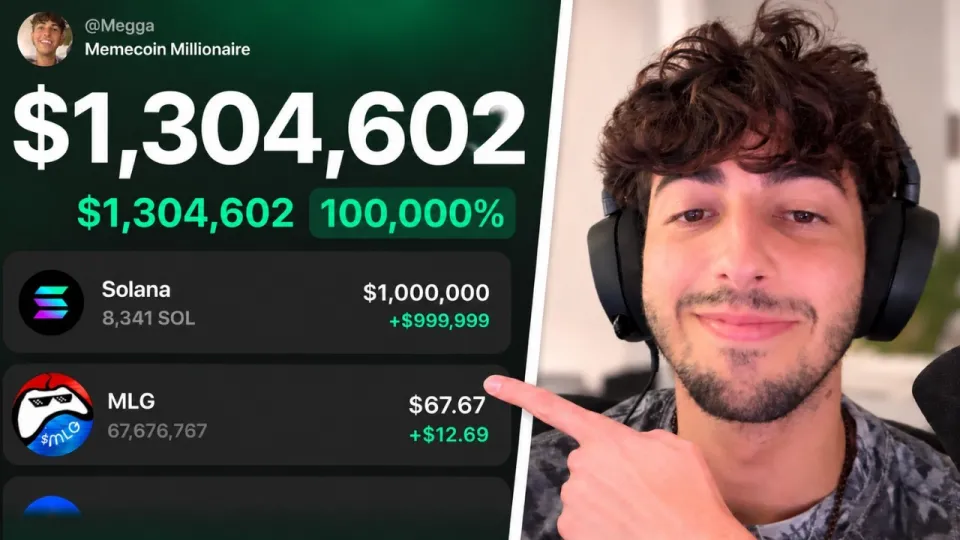
Video: How I Made $1,000,000 Trading Memecoins (FULL BREAKDOWN)
You can order the same kind of articles for your own video to boost it on YouTube and Google. Just message the Telegram bot @sat_sit_bot. Articles with your video embedded are written and posted by the bot itself — on popular topical sites (no ads). Your first 50 articles are free.
· based on the channel Megga
Key takeaways
- Megga's full breakdown video reports a $1,000,000 cumulative PnL from trading memecoins, built over a long stretch of daily screen time rather than one lucky trade.
- The routine described is a 9-to-12-hour daily grind in the "trenches" — early memecoin launches on Solana-style venues, monitored through tools like Padre.
- The video's free course link and the trading platform link are the two practical resources attached to the breakdown.
- Audience pushback in the comments is blunt: profits in memecoins come from other participants, and rug pulls and phishing drains are a standard part of the risk set.
- Community is treated as infrastructure: X timelines, streams and voice chats substitute for having friends trading alongside you.
Meme coin trading is the practice of buying and selling tokens with no cash flow, no product and no valuation anchor, where price is driven almost entirely by attention and liquidity. In his full breakdown, Fortnite pro turned trader Megga reports a $1,000,000 cumulative PnL from memecoins and attributes it to a 9-to-12-hour daily routine in the trenches rather than a single lucky entry; the free course he attaches to the video is available through this registration link.
What a $1,000,000 meme coin PnL actually represents
A seven-figure PnL figure is a running total of realized and unrealized gains across hundreds of trades, not a bank balance and not a single windfall. Megga frames the number as the output of repetition: many small and medium positions, a handful of large ones, and a long tail of losses that have to be absorbed without blowing up the account. Anyone reading the figure as "one good call" is misreading the format — the same video spends far more time on process than on any individual token.
Three things separate that process from casual buying:
- Volume of attempts. Hundreds of decisions per month, most of them wrong or neutral.
- Position sizing that survives being wrong repeatedly, so a single rug does not end the run.
- Speed of exit. In memecoins the sell side is the skill; the buy side is mostly attention.
Inside the 9-to-12-hour trenches routine
The daily grind in memecoin trading is monitoring, not clicking buy — most hours go into filtering launches and watching whether volume and holders actually follow the narrative. The most-asked question under the video is precisely this: what fills those hours? The honest answer is that the work is mostly rejection. A trader scans new pairs, checks contract behavior, holder distribution, social traction and whether the chart is being painted by a few wallets, and discards the overwhelming majority of candidates.
A practical breakdown of that session looks like this:
- Scan phase. New launches and migrations, sorted by early volume rather than by ticker familiarity.
- Filter phase. Contract checks, holder concentration, whether the deployer wallet has a history, whether liquidity is locked or plausible.
- Timing phase. Entering while the narrative is still forming, not after the timeline is already loud.
- Exit phase. Scaling out into strength, accepting that the top is never sold perfectly.
- Review phase. Logging what worked, because memory in this market is worthless after a week.
Megga's setup for execution is a low-fee trading terminal, linked in the video description as the platform he recommends; the free course sits behind the same funnel.
Why the community replaces having friends in the trade
Trading memecoins alone is the default state, and the substitute for a desk of colleagues is the timeline — X posts, live streams and voice chats where people narrate what they are buying and why. Several viewers describe exactly this: no friends trading alongside them, so they learn by listening to other people's comms and copying the reasoning, not the positions. That works only if you treat it as education rather than as signals; the moment you buy because someone else is loud, you become the exit liquidity for their position.
Networking has a price of admission too. A recurring question in the comments is how much all-time PnL you need before joining group voice chats or approaching other traders directly — the practical threshold is less about the number and more about whether you can describe your own risk rules, because that is what makes you useful in a call rather than a liability.
The risks the highlight reel cannot hide
Memecoin profits are paid by other participants, and the comment section under any seven-figure breakdown says so plainly: money has to come from somewhere, and late buyers are usually where it comes from. Two failure modes dominate the losses described by viewers — phishing drains that empty a wallet after a good run, and rug pulls where liquidity disappears before the exit is possible. Both are structural, not bad luck.
A short risk checklist worth internalizing before any position:
- Wallet hygiene. Separate wallets for trading and holding, hardware signing for anything meaningful, and no blind signature requests from links in group chats.
- Liquidity reality. If your size cannot exit in one or two sells without moving the price 30%, you are the liquidity.
- Narrative half-life. Meme cycles compress; a thesis that was fresh on Monday is exit liquidity by Thursday.
- Drawdown math. A 50% loss requires a 100% gain to recover; the reason to size small is arithmetic, not cowardice.
- Mental state. Trading after a drain or a bad week is how accounts get rinsed twice.
How to tell whether a "tech meta" token is early or already late
Judging whether a memecoin narrative has room left is a skill built from pattern recognition across previous cycles, not from a single indicator. Tokens that ride a technical or cultural meta — the kind of names that trend and then fade — tend to follow a recognizable arc: quiet accumulation, a first vertical move, a wave of derivative copycats, then decay as attention rotates. The edge comes from entering before the copycats exist, which means accepting lower certainty and smaller size.
The realistic version of "getting in early" is not catching a launch at a $30k market cap on every attempt; it is being present for enough launches that one of them works, while the filters keep the failures cheap. If you have a job and cannot watch charts for nine hours, the honest adjustment is smaller size, fewer trades and a narrow watchlist — not a wider one.
Useful links
- Free course from the video: https://whop.com/checkout/plan_Jfp7BxTu8pWGu/?session=chs_HL1L0oQ9QcTEa3
- Trading platform recommended in the description (lowest fees): https://trade.padre.gg/rk/megga
- Twitch: http://www.twitch.tv/megga
- TikTok: https://www.tiktok.com/@meggafaze
- X: https://twitter.com/megga
Bottom line
Megga's breakdown is worth watching as a process document rather than a profit screenshot: the million is the residue of thousands of hours of screening, sizing and exiting, plus a tolerance for being wrong most of the time. The channel «Megga» is transparent about the grind and about the losses, which is more than most memecoin content offers. Treat the free course behind the registration link as a starting point for learning the mechanics, and treat every dollar you put in the trenches as money you can afford to lose entirely.
Questions & answers
How much capital do you need to start trading meme coins?
There is no fixed minimum, but the practical constraint is position sizing: you need enough to take many small positions without one loss ending the run, and little enough that a total loss does not change your life. Traders in the comments describe working with modest all-time PnL before joining group chats; the number matters less than having clear risk rules you can explain.
Is a $1,000,000 PnL the same as having a million in the bank?
No. PnL is a running total of gains and losses across many trades, including open positions, and it says nothing about drawdowns taken along the way or taxes owed. A seven-figure cumulative figure can coexist with long losing streaks and significant volatility in account equity.
What are the biggest risks in memecoin trading?
Rug pulls, where liquidity vanishes before you can exit, and wallet drains from phishing links or malicious signature requests are the two most common ways traders lose everything. Both are structural features of the market rather than rare accidents, which is why separate wallets and strict link discipline matter more than any single trade idea.
Can you trade meme coins with a full-time job?
Yes, but not with the same intensity as a nine-to-twelve-hour screen routine. The realistic adaptation is a narrow watchlist, smaller position sizes and fewer trades, accepting that you will miss most launches. Trying to replicate a full-time grind in two evening hours usually produces worse decisions, not more opportunities.
Source: How I Made $1,000,000 Trading Memecoins (FULL BREAKDOWN) · Markdown version